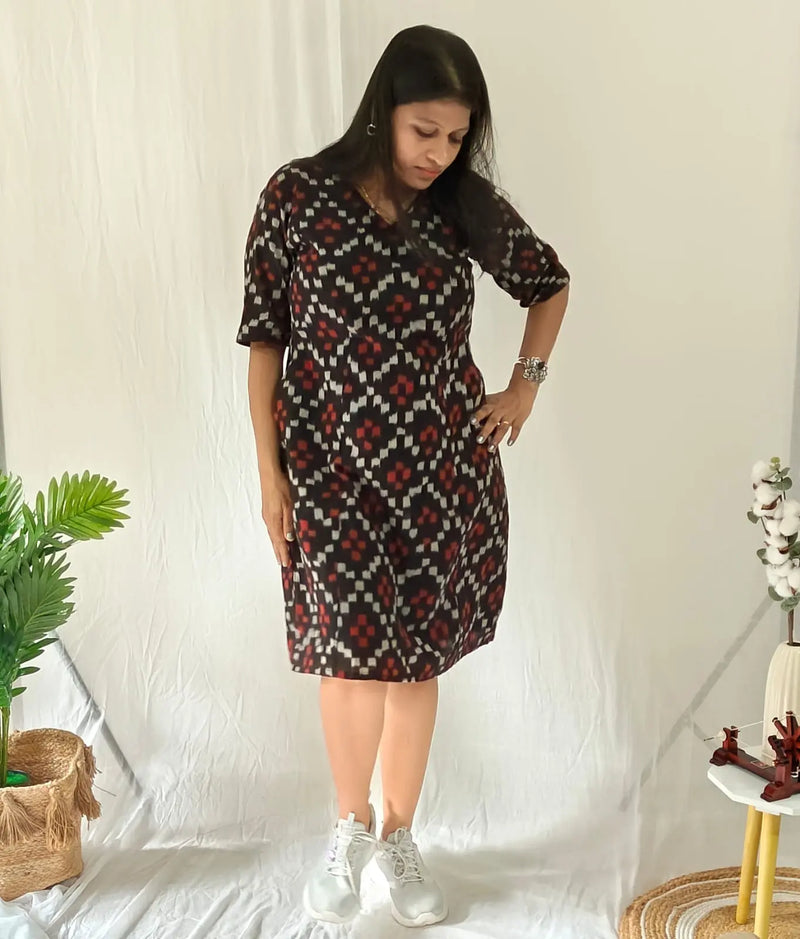
8 Indian Block Print Motifs and What They Mean
Look closely at any hand block-printed fabric and you'll notice the same shapes coming back: tiny flowers, teardrops, trellises, elephants. These motifs aren't random decoration. Many carry centuries of meaning, borrowed from nature, religion, architecture and trade.
Once you know what to look for, you'll start spotting them everywhere. Here are eight of the most loved motifs in Indian block printing and the stories behind them.
1. Buta: the little flower sprig
A buta is a small flowering plant or sprig, and its smaller cousin is the buti. Printed in neat rows across the fabric, butas create a light, airy all-over pattern. Fine, delicate butas on pale grounds are one of the signatures of Sanganeri printing from Rajasthan.
Spot it: repeated tiny flowers with a stem and a leaf or two, evenly spaced across the cloth.

2. Paisley (Keri): the mango teardrop
Known in India as keri or ambi (both meaning mango), the paisley is a teardrop with a curled tip. It travelled through Persian art and became world-famous through Kashmiri shawls. It is widely read as a symbol of life, growth and fertility.
Spot it: a rounded drop shape with a curving point, often filled with smaller flowers or lines.

3. Lotus (Kamal): purity
The lotus grows from muddy water yet blooms clean, which is why it stands for purity across Indian traditions. It is closely associated with the goddess Lakshmi and appears in temple art, jewellery and textiles alike.
Spot it: layered pointed petals opening upward, sometimes resting on round leaves.

4. Jaal: the trellis
Jaal means net. It is an all-over lattice of curving or straight lines, usually with a flower set inside each opening. Its rhythm echoes the carved jali screens of Mughal architecture.
Spot it: a continuous network of lines covering the whole fabric, framing small repeated motifs.

5. Elephant (Hathi): royalty and good fortune
Elephants have long been linked with royalty, strength and auspicious beginnings in India. They are a favourite in Rajasthani prints, often shown in a line as if walking in a procession, sometimes wearing a decorated saddle cloth.
Spot it: rows of elephant silhouettes, usually in earthy browns, reds or black.

6. Peacock (Mor): beauty and love
India's national bird is a symbol of beauty, grace and love. It is tied to the monsoon, when peacocks dance, and to Krishna, who wears a peacock feather in his crown.
Spot it: a bird with an upright crest, often with its tail fanned out or trailing behind.

7. Tree of Life: growth and connection
The tree of life brings roots, branches, leaves, flowers and sometimes birds into one flowing design. It speaks of growth and of everything being connected. Large tree-of-life designs were famously made on Indian printed and painted cottons for centuries.
Spot it: a central trunk branching outward, with blossoms and leaves balanced on both sides.

8. The Ajrakh Star: geometry from Sindh and Kutch
Ajrakh, practised in Kutch in Gujarat, Barmer in Rajasthan and Sindh, is known for intricate geometric patterns: stars, rosettes and interlocking shapes, traditionally in deep indigo and red. Its designs are often linked to the geometric tile and architectural art of the Islamic world.
Spot it: a dense, symmetrical grid of stars or medallions, usually in indigo, crimson and white
 .
Why motifs matter
Every motif is carved by hand into a wooden block, then stamped onto fabric one impression at a time. That's why the same motif can look slightly different across a single piece. It's the mark of a human hand. (Here's how to tell real block print from screen print.)
Next time you wear a block print, take a moment to read its pattern. Look closely at the Sanganeri and Ajrakh pieces in our Rangrez Runway dresses and Indi Breeze kaftans, and see how many of these motifs you can find.